
Authors
Marhamah, M.Pd
Prof. Dr. Ratu Ilma Indra Putri, M.Si
Prof. Dr. Zulkardi, M.I.Kom., M.Sc
Prof. Dr. Yusuf Hartono, M.Sc
Category
Reference Book
ISBN
In Progress
e-ISBN
In Progress
Size
15,5 x 23 cm
Pages
vi + 138 page
Year of Publication
August 2026
Price
Rp 175.000
Synopsis
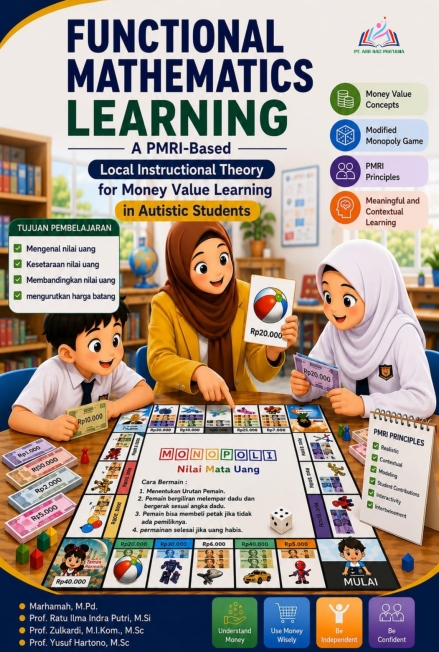
Learning about the value of money is one of the important components of functional mathematics. Money is encountered in various daily activities, such as buying goods, recognizing denominations, comparing prices, counting money, determining the amount of change, and making simple purchasing decisions. Therefore, mastery of money-value concepts is not only related to mathematical achievement but also to the development of students’ independence and ability to participate in social and economic activities within their environment.
For autistic students, learning the value of money can present particular challenges. Differences in cognitive processing, communication, attention, perception, and adaptive functioning may influence how students understand abstract mathematical concepts. Consequently, mathematics instruction needs to move beyond conventional approaches and provide learning experiences that gradually connect concrete objects, visual representations, symbolic notation, and authentic situations. Such an approach can help students construct mathematical understanding based on experiences that they can see, manipulate, and relate to their everyday lives.
This book develops a learning perspective based on Indonesian Realistic Mathematics Education (Pendidikan Matematika Realistik Indonesia/PMRI). PMRI emphasizes mathematics as a human activity and encourages students to develop mathematical concepts through meaningful contexts. In this perspective, mathematics is not presented simply as a set of ready-made rules but is reconstructed through students’ experiences, strategies, representations, and interactions. These principles provide a strong foundation for designing mathematics learning that is contextual, gradual, and responsive to the learning characteristics of autistic students.
The concept of a Local Instructional Theory (LIT) is also central to this book. A local instructional theory provides a theoretically informed description of how students may learn a particular mathematical topic through a sequence of carefully designed instructional activities. In the context of this book, the LIT focuses specifically on learning the value of money through realistic and meaningful situations. The instructional sequence is designed to provide opportunities for students to explore, represent, compare, calculate, and apply money-related concepts in ways that are appropriate to their developmental and learning needs.
The learning activities presented in this book are grounded in contexts that are familiar to students. Situations such as identifying coins and banknotes, matching money with prices, purchasing simple items, comparing the values of different denominations, and calculating change can become meaningful learning environments. Through these activities, mathematical concepts are introduced not as isolated knowledge but as tools for solving problems encountered in everyday life. This contextual orientation is expected to strengthen both mathematical understanding and functional competence.
Another important aspect emphasized in this book is the use of multiple representations. Autistic students may benefit from the systematic use of concrete materials, pictures, symbols, tables, price labels, role-play, and other visual supports. Moving gradually from concrete experiences toward more abstract representations can facilitate conceptual understanding while reducing unnecessary cognitive demands. The combination of visual structure, repetition, meaningful context, and guided interaction can create a learning environment that is more accessible and supportive. This book also places students at the center of the learning process. Teachers are not merely transmitters of mathematical procedures but facilitators who observe students’ strategies, provide appropriate scaffolding, encourage communication, and guide students toward more formal mathematical ideas. Students’ responses, errors, strategies, and discoveries become valuable sources of information for refining instructional activities. In this way, learning becomes a dynamic process in which mathematical knowledge develops through interaction between students, teachers, learning materials, and realistic contexts