
Authors
Dr. Novi Susanti, S.Si., M.Pd
Prof. Dr. Ratu Ilma Indra Putri, M.Si
Prof. Dra. Nyimas Aisyah, Ph.D
Dr. Hartono, M.A
Category
Reference Book
ISBN
In Progress
e-ISBN
In Progress
Size
15,5 x 23 cm
Pages
viii + 180 page
Year of Publication
September 2026
Price
Rp 155,000
Synopsis
The central tendency topic, particularly mean, median, and mode, is an important component of statistical understanding. These concepts are not merely mathematical formulas to be memorized, but tools for interpreting, comparing, summarizing, and communicating data. For vocational students, the ability to understand and use central tendency can support decision-making in practical situations. Therefore, learning central tendency should provide students with opportunities to explore data, reason mathematically, interpret results, and communicate conclusions rather than focusing solely on computational procedures.
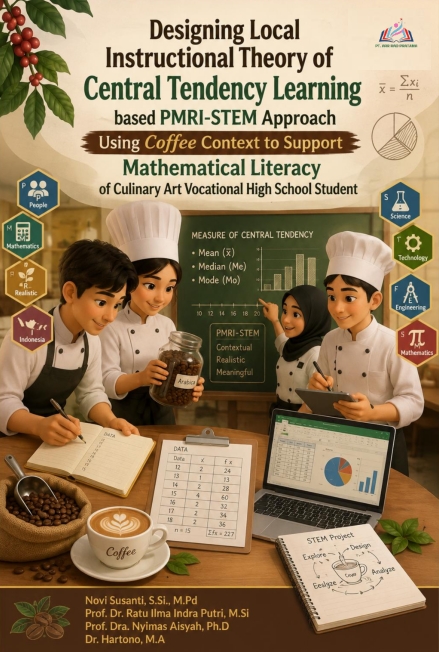
This book places the coffee context as a meaningful learning environment for developing students’ mathematical understanding. Coffee is closely connected with everyday life and can also be associated with vocational activities, particularly culinary practices. Characteristics such as coffee quantities, serving portions, preparation times, customer preferences, prices, or other measurable aspects can provide authentic situations through which students can encounter and investigate statistical ideas. Through such contexts, mathematics is expected to become more concrete, familiar, and connected to students’ vocational experiences.
The learning approach presented in this book integrates Pendidikan Matematika Realistik Indonesia (PMRI) with STEM. PMRI emphasizes meaningful contexts, students’ informal strategies, progressive mathematization, interaction, and the development of mathematical ideas from situations that are realistic for learners. Meanwhile, the STEM perspective encourages students to integrate mathematics with science, technology, and engineering-related thinking. The combination of these perspectives provides a foundation for designing learning experiences that are contextual while also encouraging exploration, problem solving, creativity, and analytical thinking.
The integration of PMRI and STEM is particularly relevant to vocational education because vocational learning is expected to prepare students to respond to authentic problems and professional situations. Students need not only technical competencies but also mathematical literacy, critical thinking, communication, collaboration, and the ability to make decisions based on information. Mathematics learning can therefore function as a bridge between conceptual knowledge and practical vocational competence.
A major focus of this book is the development of a Local Instructional Theory (LIT). LIT provides a theoretical framework for describing how a particular mathematical topic can be learned through a carefully designed sequence of instructional activities. Rather than presenting learning as a fixed set of procedures, the LIT perspective views classroom learning as a process in which students develop mathematical understanding through meaningful activities, strategies, representations, discussion, and reflection. In this context, the design of central tendency learning is closely connected to the characteristics of vocational students and the coffee context.
The development of instructional activities described in this book is oriented toward supporting mathematical literacy. Mathematical literacy involves the capacity to formulate, employ, interpret, and evaluate mathematics in various contexts. In learning central tendency, students are encouraged to move beyond calculating the mean, median, or mode toward understanding what these measures mean in a particular situation. Students can be invited to examine data, determine appropriate measures, interpret the information obtained, and use their findings to justify decisions. The coffee context also provides opportunities to introduce students to authentic data and practical decision-making. For example, students may encounter data related to coffee production, ingredient quantities, serving preferences, preparation processes, customer choices, or sales information. Such situations can encourage students to ask questions, identify relevant information, organize data, perform calculations, interpret statistical measures, and communicate meaningful conclusions. In this way, the learning process can develop both mathematical competence and vocational awareness.