
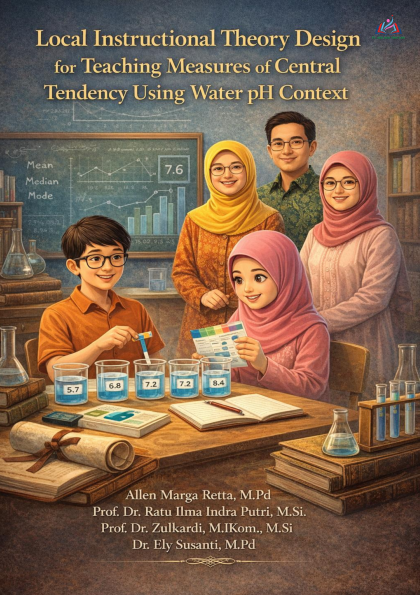
Penulis
Allen Marga Retta, M.Pd
Prof. Dr. Ratu Ilma Indra Putri, M.Si
Prof. Dr. Zulkardi, M.IKom., M.Si
Dr. Ely Susanti, M.Pd
Kategori
Buku Referensi
e-ISBN
978-634-7593-08-5
Ukuran
14 x 20 cm
Halaman
vii + 205 hlm
Tahun Terbit
Februari 2026
Harga
Rp 125.000,-
Sinopsis
This work originates from the practical need to improve how statistical concepts—particularly measures of central tendency—are taught in classrooms. Too often, these topics are delivered procedurally, with limited connection to real-life situations. As a result, students may master formulas without truly understanding their meaning or usefulness. This book responds to that gap through a context-based instructional design.
Local Instructional Theory (LIT) is used as the main framework in this book. It serves not only as a theoretical model but also as a practical guide for designing learning trajectories, instructional activities, and pedagogical strategies. It explains what to teach, how to teach it, and why specific instructional paths support students’ conceptual development.
The water pH context is selected as an authentic and relevant learning setting. It connects mathematics with environmental science and everyday life. Through pH data, students can explore, collect, organize, and analyze real numerical information, making the concepts of mean, median, and mode more concrete and meaningful.
This book presents theoretical foundations of measures of central tendency, contextual learning approaches, and design-based research methodology. It also provides structured instructional sequences, predicted student responses, teacher intervention strategies, and multiple forms of mathematical representation that may emerge during learning activities.
A major component of this book is the development of a Hypothetical Learning Trajectory. Each stage is described with its conceptual goals, learning tasks, and indicators of student understanding. This structure is intended to help educators plan instruction that is coherent, progressive, and responsive to student thinking. The instructional approach promoted here emphasizes exploration, discussion, data representation, and reflection. Students are encouraged to construct their understanding through guided experiences rather than passive reception. Teachers are positioned as facilitators who support and refine students’ emerging ideas.